Morar
The Sorrows of Young WertherMorar is a celebrated warrior whose death turns martial renown into an elegy about grief, mortality, and remembrance. The songs portray him as swift and fearsome in battle, gentle in repose, and lost so completely that only a few rough stones mark his grave; against that physical absence, the song promises that his name will endure.
Identity and Character
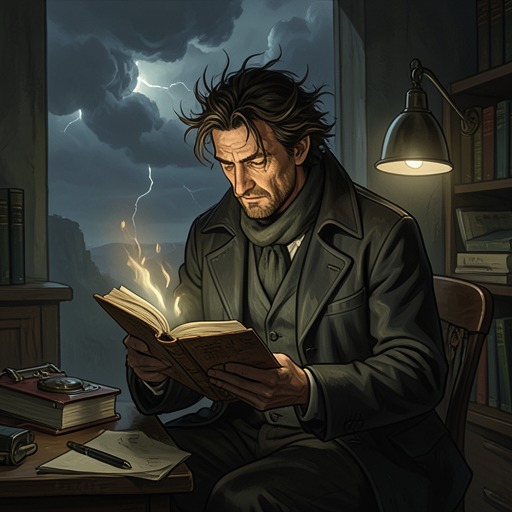
Morar is called the first among mortal men and is praised as a hero whose speed, anger, and fighting power seem elemental. He is swift as a roe on the desert and terrible as a meteor of fire; his wrath resembles a storm, while his sword flashes like lightning in battle. Many fall by his arm, consumed by the force of his anger.
That violence does not define him in every setting. On returning from war, Morar’s brow is peaceful: his face is compared to the sun after rain and the moon in a quiet night, and his composure to a lake after the wind has fallen. The contrast gives the warrior a double aspect, making his calm at home as memorable as his destructive strength in combat.
Death and Family Grief
Morar has fallen before the song recounts his fame. His father, an old man who has no son but Morar, has heard of his son’s victories and of dispersed enemies, but not of the wound that killed him. The lament dwells on that cruel gap between public renown and private loss: the father knows the hero’s reputation only to discover that its defining cost has already been paid.
Morar’s death also leaves his sister Minona in grief. She is described as the sister of the chariot-borne Morar, and her tears belong to a wider mourning that overtakes the song. His mother is already dead, and the lament stresses that no mother remains to mourn him and no beloved maiden weeps for him. The father’s sorrow is therefore sharpened by the isolation of his loss: Morar was his only son, and the family line has no son to continue it.
Grave and Memorial
The smallness of Morar’s grave is set against the greatness of his former life. Three steps suffice to compass it; four moss-headed stones are its only memorial. A tree with scarcely a leaf and long grass whistling in the wind identify the resting place to a hunter. The landscape offers no monument equal to the warrior’s reputation, only sparse signs that can be read by someone passing through.
The lament insists that death has silenced Morar beyond the reach of family calls. His father cannot wake him, and the song asks when morning will come in the grave. Yet the physical grave is not the final measure of his survival. Though Morar has left no son, the song will preserve his name, and future generations will hear of the fallen hero.
Narrative Role
Morar appears through a chain of song and remembrance rather than through direct action in the present. At a gathering where grief for Colma has already moved the listeners, Ullin takes up his harp and offers the song of Alpin; within this layered performance, Morar’s fall becomes another remembered loss. His story extends the lament from one bereavement to another, while the father’s grief gives the song’s praise an intimate human consequence.
The memorial holds two measures of fame in tension. In life, Morar’s might is rendered through storm, fire, and lightning; in death, his grave is only four stones beneath a nearly bare tree. Song cannot restore him or answer his father, but it can carry his name beyond the immediate scene of mourning. Morar’s lasting presence is therefore not bodily or familial: it is the voice of the lament itself.